
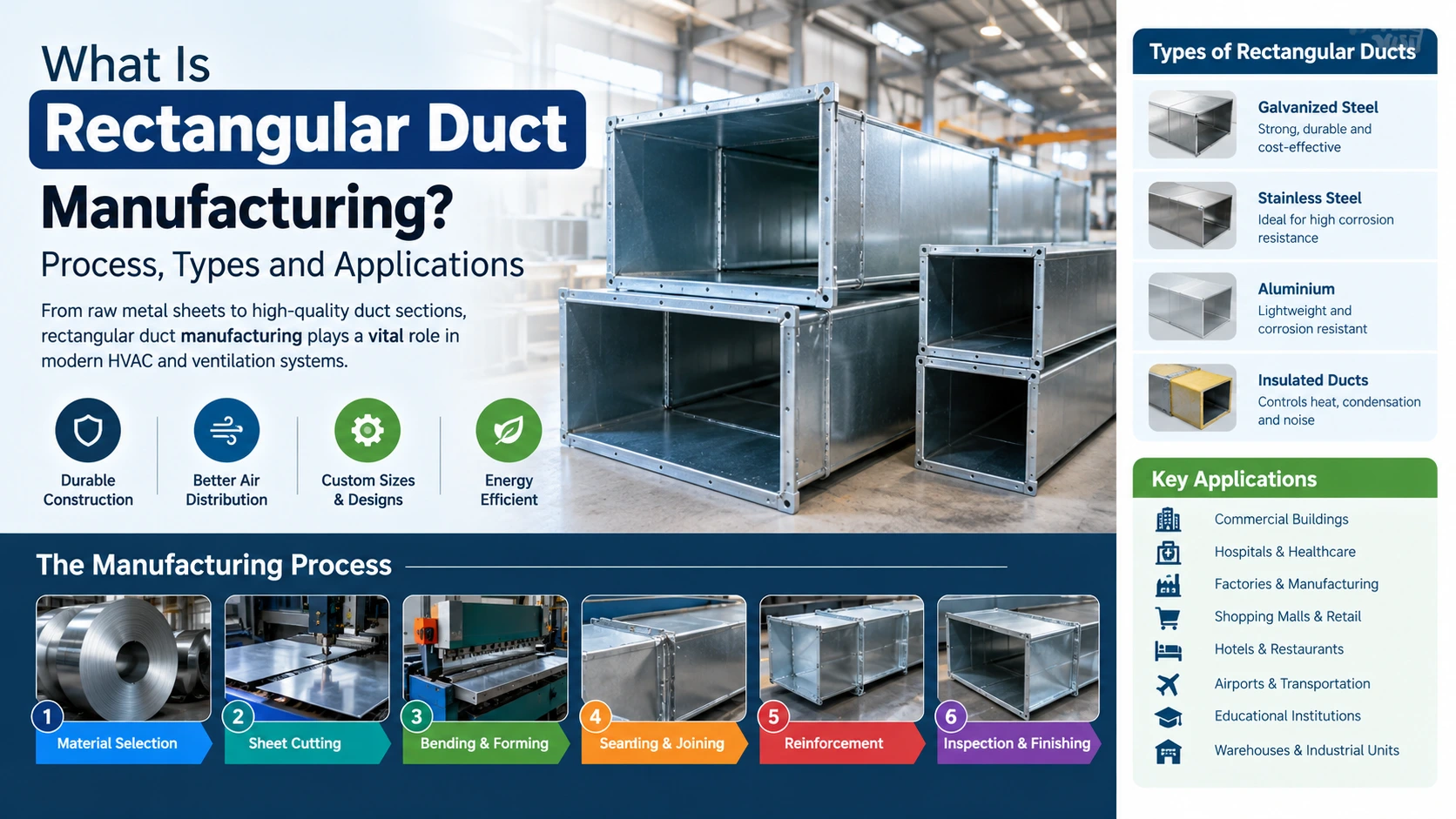
Rectangular duct manufacturing is the process of converting metal sheets or coils into rectangular-shaped ducts of required dimensions. The manufacturing process involves material selection, cutting, bending, forming, joining, reinforcing and finishing. Accurate manufacturing is important because the quality of ductwork directly affects its strength, air leakage, installation and overall HVAC performance.
Heating, ventilation and air conditioning systems need a properly designed duct network to move air from one area to another. Among the different duct shapes available, rectangular ducts are widely used in commercial, industrial and large building HVAC systems. They are especially useful where ceiling height or installation space is limited.
Companies such as Ductovent Pvt. Ltd. focus on manufacturing ducting solutions according to different ventilation and air-distribution requirements.
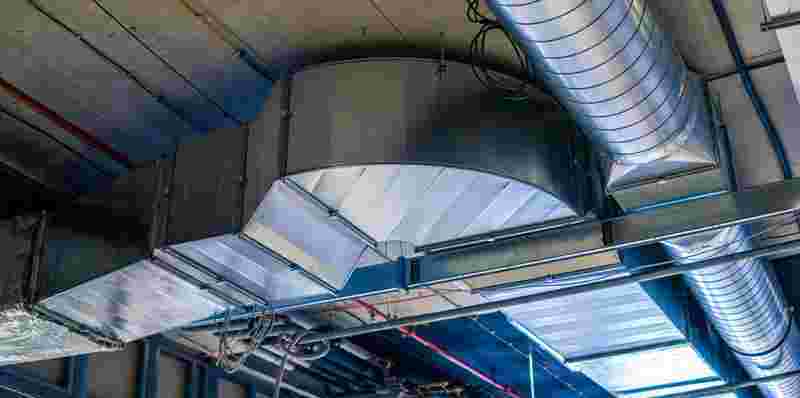
What Is a Rectangular Duct?
A rectangular duct is an air passage with a rectangular or square cross-section. It is used to carry conditioned, fresh, return or exhaust air through different sections of a building.
These ducts are commonly made from galvanized steel, although stainless steel and aluminium can also be selected for specific operating environments. The correct material, sheet thickness and reinforcement depend on factors such as duct dimensions, pressure requirements and operating conditions.
One major advantage of rectangular ductwork is its ability to fit into spaces where vertical clearance is limited. Its dimensions can be adjusted according to the available installation area while maintaining the required air passage.
Rectangular Duct Manufacturing Process
Manufacturing a quality rectangular duct requires several carefully controlled steps. Modern fabrication facilities may use automated equipment to improve accuracy and production speed.
1. Design and Measurement
The process starts with the duct design. Manufacturers determine the required width, height, length, material and sheet thickness according to the project specifications. The duct layout also considers elbows, branches, transitions and other fittings required for the complete system.
Correct measurements at this stage help reduce material waste and avoid installation problems later.
2. Material Selection
The next step is selecting a suitable material. Galvanized steel is frequently used for HVAC ductwork because it provides good strength and practical corrosion protection. Stainless steel may be selected where better corrosion resistance or special hygiene requirements are important, while aluminium provides a lightweight option for suitable applications.
Material selection should always consider the operating environment and purpose of the duct system.
3. Sheet Cutting
Once the material is selected, the sheet or coil is cut according to the required duct dimensions. Modern manufacturing systems can use automated cutting equipment to maintain consistent measurements and reduce unnecessary material waste.
Accurate cutting is essential because even small dimensional errors can create difficulties during forming and assembly.
4. Bending and Forming
The cut metal is then bent and formed into the required rectangular shape. Fabrication machinery creates accurate folds so that different sides of the duct can be joined properly.
Modern coil-line systems can perform several fabrication operations efficiently, making them useful for producing larger quantities of rectangular duct sections.
5. Seaming and Joining
After forming, the edges are connected using an appropriate seam or locking method. Longitudinal seams create the duct body, while transverse joints are used to connect one duct section to another during assembly and installation.
The joint system needs to provide strength while helping control unwanted air leakage.
6. Reinforcement
Larger rectangular ducts or ducts operating under higher pressure may require additional reinforcement. Stiffeners, structural members or tie rods can be used depending on duct dimensions and design requirements.
Proper reinforcement helps the duct maintain its shape and reduces excessive movement or deformation during operation.
7. Inspection and Finishing
The completed duct sections are checked for dimensions, joints, edges, overall shape and fabrication quality. Good inspection helps identify manufacturing issues before the ductwork reaches the installation site.
Main Types of Rectangular Ducts
Rectangular ducts can be classified according to their construction, material and intended application.
Galvanized Steel Rectangular Ducts: These are commonly used for general HVAC supply, return and ventilation systems. They provide a useful combination of strength, durability and cost-effectiveness.
Stainless Steel Rectangular Ducts: Stainless steel ductwork can be suitable for demanding environments where corrosion resistance, cleanliness or durability is particularly important.
Aluminium Rectangular Ducts: Aluminium ducts are lightweight and naturally corrosion resistant, making them useful for selected ventilation projects where lower weight is beneficial.
Insulated Rectangular Ducts: These ducts incorporate insulation to help control heat transfer, condensation and noise. They are commonly used when conditioned air needs to travel through areas with different temperatures.
Applications of Rectangular Duct Manufacturing
Rectangular duct systems are used across many sectors because they can be manufactured in different dimensions and configurations.
Common applications include:
- Commercial office buildings
- Shopping malls and retail spaces
- Hotels and restaurants
- Hospitals and healthcare facilities
- Factories and manufacturing units
- Warehouses
- Airports and transportation facilities
- Educational institutions
- Industrial ventilation systems
- Large HVAC installations
They can form part of supply-air, return-air, fresh-air and exhaust-air networks depending on the system design.
Benefits of Rectangular Ducts
One of the biggest benefits of rectangular ductwork is space flexibility. The width and height can be selected to suit restricted ceiling spaces and building layouts.
Rectangular ducts also offer convenient connections with many HVAC components, including air handling equipment, dampers, filters, grilles and diffusers. They can be manufactured in many sizes and fitted with transitions, bends and branches to create a complete air-distribution network.
Another important advantage is customization. Manufacturers can produce duct sections according to specific project drawings instead of depending only on fixed standard dimensions.
Why Manufacturing Quality Matters
A duct may look simple, but poor fabrication can affect the complete HVAC system. Incorrect dimensions, weak joints, insufficient reinforcement or poorly formed sections may contribute to air leakage, vibration, noise or installation difficulties.
Industry guidance for rectangular duct construction therefore considers factors such as material thickness, reinforcement spacing, longitudinal seams, transverse joints, tie rods, hangers and supports. Quality manufacturing should follow the project’s specified engineering and applicable construction requirements.
Conclusion
Rectangular duct manufacturing is an important part of modern HVAC and ventilation systems. The process transforms sheet metal into accurately sized duct sections through designing, cutting, forming, seaming, joining, reinforcing and inspection.
From offices and shopping malls to factories, hospitals and large commercial facilities, rectangular ducts provide a practical solution for moving air through a building. Selecting the correct material, dimensions, joints and reinforcement helps create a durable and reliable duct system.
Ductovent Pvt. Ltd. understands the importance of accurate fabrication and application-based ducting solutions. Properly manufactured rectangular ductwork can support efficient air distribution, easier installation and dependable long-term performance in commercial and industrial HVAC projects.