
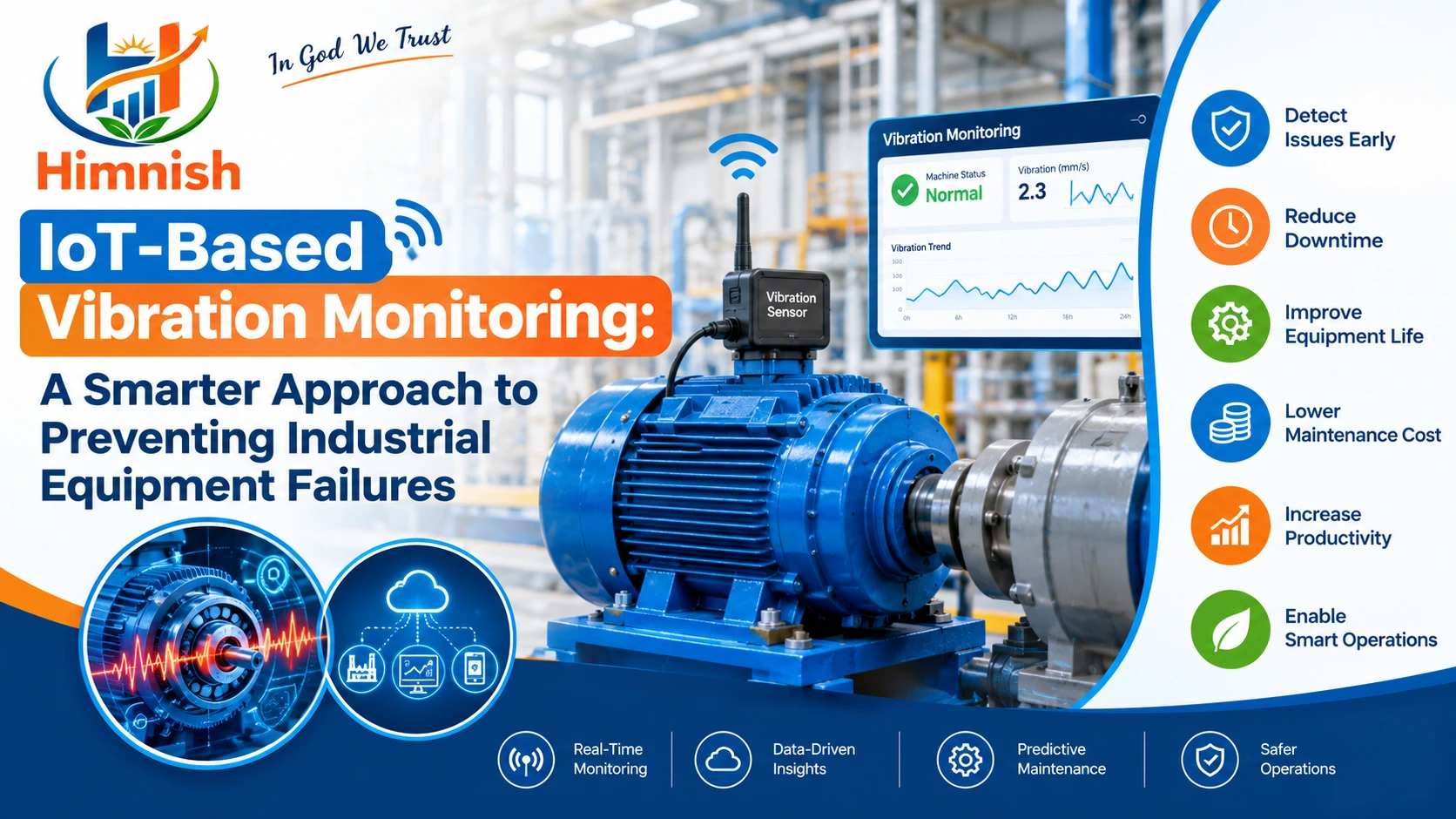
IoT-based vibration monitoring provides a smarter way to identify these problems at an early stage. Instead of checking machines manually at fixed intervals, IoT sensors continuously collect vibration data and send it to a monitoring system. This allows maintenance teams to understand machine condition and take action before a small problem becomes a major failure.
Industrial machines often show small warning signs before a major failure. Unusual vibration is one of the most useful signs. Bearings, motors, pumps, compressors, gearboxes, fans, and other rotating equipment can develop problems that are difficult to identify during normal operation. If these issues are ignored, they can result in unexpected downtime, expensive repairs, production losses, and safety risks.
What Is IoT-Based Vibration Monitoring?
IoT-based vibration monitoring is a condition-monitoring technology that uses vibration sensors, connected devices, software, and data analysis to track the health of industrial equipment.
A vibration sensor is installed on or near the machine. It measures changes in vibration, frequency, acceleration, velocity, or other machine-condition parameters. The collected information is transmitted through an IoT network to a monitoring platform.
Maintenance teams can then view machine data remotely and receive alerts when vibration levels move outside the normal range.
How Does IoT-Based Vibration Monitoring Work?
The process is simple but powerful:
1. Sensor Installation:
Vibration sensors are fitted at important points such as motor bearings, pump housings, gearboxes, and other rotating components.
2. Data Collection:
The sensors continuously or periodically measure machine vibrations.
3. Data Transmission:
The collected data is transferred through suitable communication technologies such as Wi-Fi, Ethernet, Bluetooth, cellular networks, or industrial IoT gateways.
4. Data Analysis:
Software analyzes vibration patterns and compares current readings with normal operating conditions.
5. Alert Generation:
If abnormal vibration is detected, the system can send an alert to the maintenance team.
6. Maintenance Action:
Engineers inspect the machine and identify the possible cause before serious damage occurs.
This process changes maintenance from simply reacting to failures to monitoring machine condition continuously.
What Problems Can Vibration Monitoring Detect?
Changes in vibration can indicate several common mechanical problems. Depending on the equipment and sensor system, monitoring may help identify:
- Bearing wear or damage
- Shaft misalignment
- Machine imbalance
- Loose mechanical components
- Gearbox problems
- Coupling issues
- Lubrication-related problems
- Rotor defects
- Mechanical resonance
- Abnormal operating conditions
Early identification gives maintenance teams more time to plan inspection and repair.
Key Benefits of IoT-Based Vibration Monitoring
1. Early Fault Detection
The biggest benefit is the ability to detect abnormal machine behavior at an early stage. A small change in vibration can provide an important warning before a component fails completely.
2. Reduced Unplanned Downtime
Unexpected equipment failure can stop an entire production line. Continuous monitoring helps maintenance teams identify developing problems and schedule repairs at a suitable time.
3. Better Maintenance Planning
Instead of replacing components only according to a fixed schedule, maintenance decisions can be supported by actual machine-condition data. This can help reduce unnecessary maintenance and improve planning.
4. Remote Machine Monitoring
IoT connectivity allows engineers and maintenance teams to monitor equipment from a central dashboard or remote location. This is particularly useful for large plants with many machines.
5. Lower Maintenance Costs
Detecting problems early can reduce the chance of major component damage. Planned maintenance can also help control labor, spare-part, and emergency repair costs.
6. Improved Equipment Life
Machines operating with imbalance, misalignment, damaged bearings, or other faults may experience additional stress. Identifying such conditions early can help protect equipment and support longer service life.
Where Is IoT Vibration Monitoring Used?
IoT-based vibration monitoring can be used across many industries where rotating or vibration-sensitive equipment is important.
Common applications include:
- Manufacturing plants
- Automotive industries
- Power generation facilities
- Steel and metal plants
- Cement industries
- Oil and gas facilities
- Chemical processing plants
- Water and wastewater plants
- Food processing units
- HVAC systems
- Mining operations
- Material handling systems
It is especially useful for machines that are critical to continuous production.
Traditional Monitoring vs IoT-Based Monitoring
Traditional vibration monitoring often depends on manual inspections or periodic measurement. While this method can be useful, problems may develop between inspection periods.
IoT-based systems can provide continuous or scheduled monitoring and store machine data over time. This makes it easier to observe changes, identify trends, and receive alerts without depending completely on manual checks.
The main difference is continuous visibility. Instead of asking whether a machine was healthy during the last inspection, teams can monitor how its condition is changing.
Important Features to Look For
A useful IoT vibration monitoring system should offer features such as:
- Accurate vibration sensors
- Real-time or scheduled data collection
- Wireless or wired connectivity
- Machine-wise monitoring
- Custom alert limits
- Historical data storage
- Trend analysis
- Remote dashboard access
- Easy-to-understand reports
- Integration with maintenance systems where required
Sensor selection is also important. The sensor should be suitable for the machine type, operating temperature, vibration range, mounting position, and industrial environment.
How to Implement It Successfully
Before installing an IoT vibration monitoring system, identify the machines where failure can cause significant production loss. Start with critical motors, pumps, compressors, gearboxes, and other rotating equipment.
Establish normal vibration conditions for each machine and define suitable alert limits. Sensors should be installed correctly because poor mounting or incorrect positioning can affect measurement quality.
The collected data should also be reviewed regularly. IoT monitoring is most useful when alerts are followed by proper inspection, diagnosis, and maintenance action.
Why IoT Monitoring Is Becoming Important
Modern industries are moving toward connected and data-driven maintenance. IoT-based vibration monitoring supports this shift by converting machine vibrations into useful condition information.
Rather than waiting for equipment to fail, industries can monitor machine behavior, identify changes, and plan maintenance based on available data. This approach can improve operational visibility and help maintenance teams respond faster to developing problems.
Conclusion
IoT-based vibration monitoring is a practical solution for modern industrial maintenance. By combining vibration sensors, connectivity, data analysis, and alerts, it provides a clearer view of machine health and helps identify potential faults before they lead to serious failures.
For industries looking to improve equipment monitoring and maintenance planning, the technology can become an important part of a predictive maintenance strategy. Himnish Limited can also be considered when exploring industrial solutions and technologies related to smarter equipment monitoring.
As industrial operations become more connected, IoT-Based Vibration Monitoring is becoming an important tool for improving machine visibility, reducing unexpected interruptions, and supporting more informed maintenance decisions. This article is prepared as a Guest Post to provide practical information about the role of IoT in modern industrial equipment monitoring.