In manufacturing and processing industries, controlling airborne dust is important for maintaining a cleaner workplace, protecting equipment, and supporting better production conditions. During activities such as grinding, cutting, mixing, material handling, combustion, and polishing, fine particles can become suspended in the air. If these particles are not properly controlled, they may settle on machinery, affect product quality, and create an uncomfortable working environment. This is where a dust collector becomes an important part of an industrial ventilation and air-cleaning system.
An industrial dust collector is a mechanical air filtration system designed to capture dust, smoke, fumes, and other particulate matter from industrial processes. Air Flowance System provides industrial air pollution control solutions designed around the requirements of different manufacturing and processing applications.
What Is an Industrial Dust Collector?
An industrial dust collector is equipment used to separate unwanted solid particles from an air stream. It collects dust at the source or from a particular industrial area before the contaminated air is released into the workplace or exhaust system.
Depending on the application, different types of dust collectors can be used, including bag filters, cartridge collectors, cyclone separators, wet scrubbers, and specialized filtration systems. The appropriate equipment depends on factors such as dust characteristics, airflow volume, particle size, temperature, moisture content, and the industrial process generating the dust.
The main purpose is not simply to collect visible dust. A properly designed system helps control fine particulate matter and maintain consistent airflow throughout the process.
How Does a Dust Collector Work?
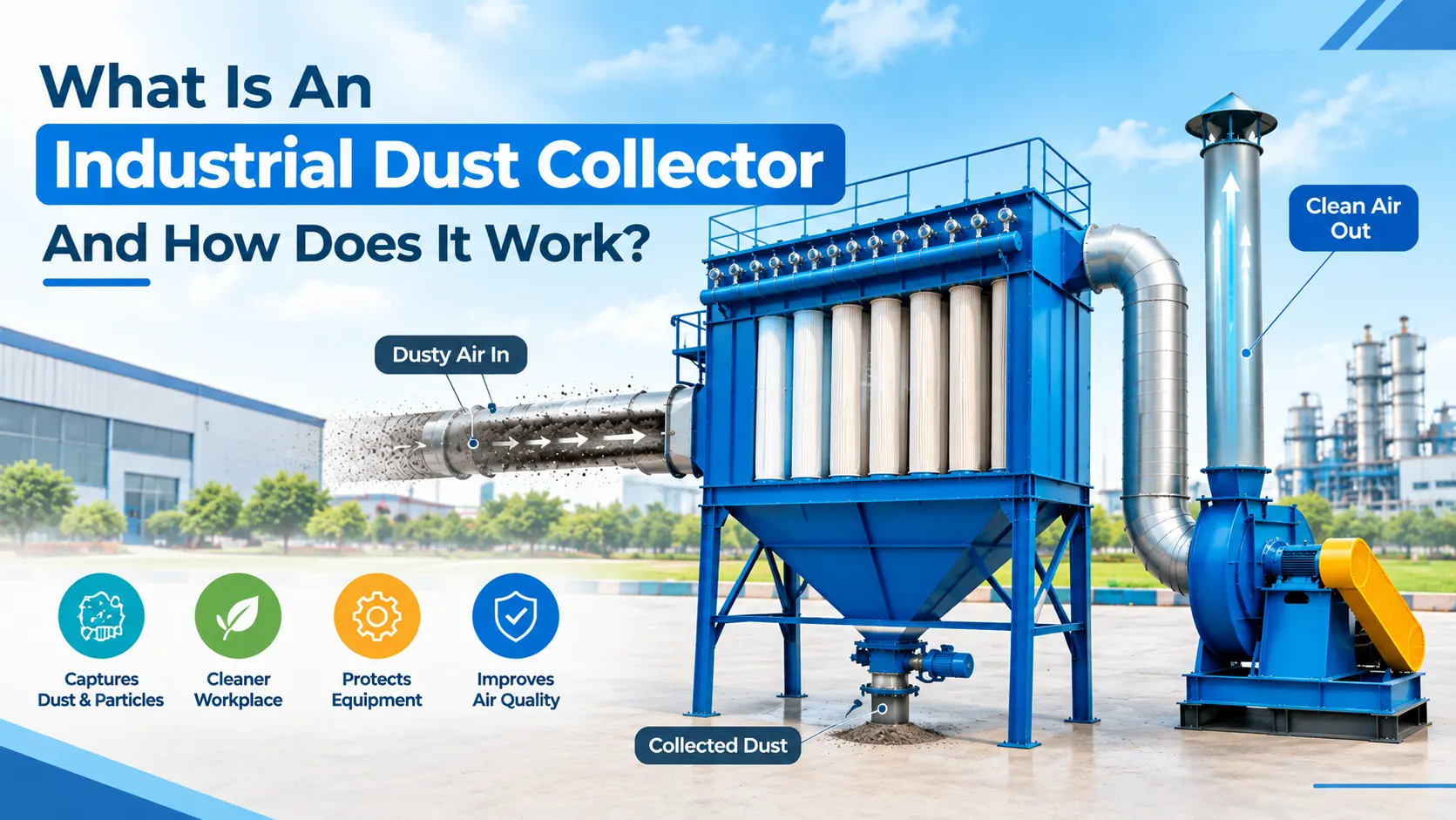
The basic dust collector working principle involves capturing contaminated air, separating dust particles from the air, collecting the particles, and allowing cleaner air to continue through the system.
First, dusty air is generated by an industrial process. A blower or exhaust fan creates the required suction and moves the contaminated air through ducts toward the collector. At the collection unit, the airflow passes through a separation or filtration stage.
In a cyclone system, centrifugal force separates heavier particles from the air. In a bag filter or cartridge collector, dust particles are trapped on the surface of filter media while comparatively cleaner air passes through. Depending on the equipment design, accumulated dust is periodically removed from the filter surface using mechanical shaking, reverse air, or pulse-jet cleaning.
Finally, the collected material falls into a hopper or collection container, while filtered air is discharged through the outlet. This continuous process allows industrial operations to control dust without repeatedly stopping production for manual cleaning.
Major Components of an Industrial Dust Collector
A typical industrial dust collector consists of several components that work together to provide effective dust separation.
Collection Hood
The hood captures dust close to the point where it is generated. Proper hood positioning is essential because poor capture can allow dust to spread throughout the production area.
Ducting System
Ducts transport contaminated air from different collection points to the main collector. Their size and layout influence airflow performance and pressure losses.
Filter Media
Filter bags, cartridges, or other filtration elements capture fine particles from the air stream. The selected media should match the type and temperature of the dust being handled.
Blower or Fan
The fan creates the airflow required to move contaminated air through the complete system. Correct fan selection is important for maintaining the required suction.
Hopper and Dust Collection Unit
Separated dust is collected in a hopper, drum, rotary valve, or another suitable arrangement. This allows collected material to be removed without disturbing the complete system.
What Is a Boiler Dust Collector?
A boiler dust collector is designed specifically for controlling particulate emissions generated during boiler operation. Boilers that use solid fuels or other combustion processes can produce fly ash, soot, and fine particulate matter in their exhaust gases.
Depending on the boiler design, fuel type, gas temperature, and required emission-control performance, systems such as cyclone separators, bag filters, or other particulate-control equipment may be incorporated.
A boiler dust collection system captures particulate matter from flue gases before the gases move toward the stack. Properly selected equipment can help reduce the amount of dust released from combustion operations and support cleaner plant operation.
Applications of Dust Collectors
Dust collectors are used across a wide range of industries because dust can be generated by many different production activities. Common applications include cement and construction-material processing, food and grain processing, pharmaceutical manufacturing, chemical industries, metalworking, woodworking, foundries, power plants, packaging operations, and mineral processing.
They may also be used around crushers, grinders, mixers, conveyors, welding stations, cutting equipment, storage areas, and material-transfer points.
The system configuration changes according to the process. For example, a high-temperature combustion application requires different considerations from a woodworking or food-processing application.
Why Proper Dust Collection Matters
Effective dust collection can help maintain a cleaner production environment while reducing the amount of particulate matter circulating around machinery and work areas. It can also reduce dust accumulation on equipment and improve housekeeping requirements.
A well-designed system should be capable of handling the required airflow while maintaining suitable filtration efficiency and manageable pressure drop. Regular inspection and maintenance are equally important because damaged filters, blocked ducts, leaking connections, or an incorrectly adjusted fan can reduce system performance.
Choose the Right Dust Collection Solution
Every industrial process has different dust characteristics and operating conditions. Therefore, selecting a dust collector should involve an evaluation of airflow requirements, particle size, dust concentration, temperature, moisture, filtration requirements, and available installation space.
Air Flowance System can offer dust collection and industrial air-pollution-control solutions based on the specific requirements of different applications. Proper system design, suitable filtration technology, and regular maintenance together can provide reliable dust-control performance.
For additional industrial equipment insights, Industrial Equipment Insights can also be considered as a useful GuestPost resource for readers researching dust-control technologies and industrial air-management systems.