
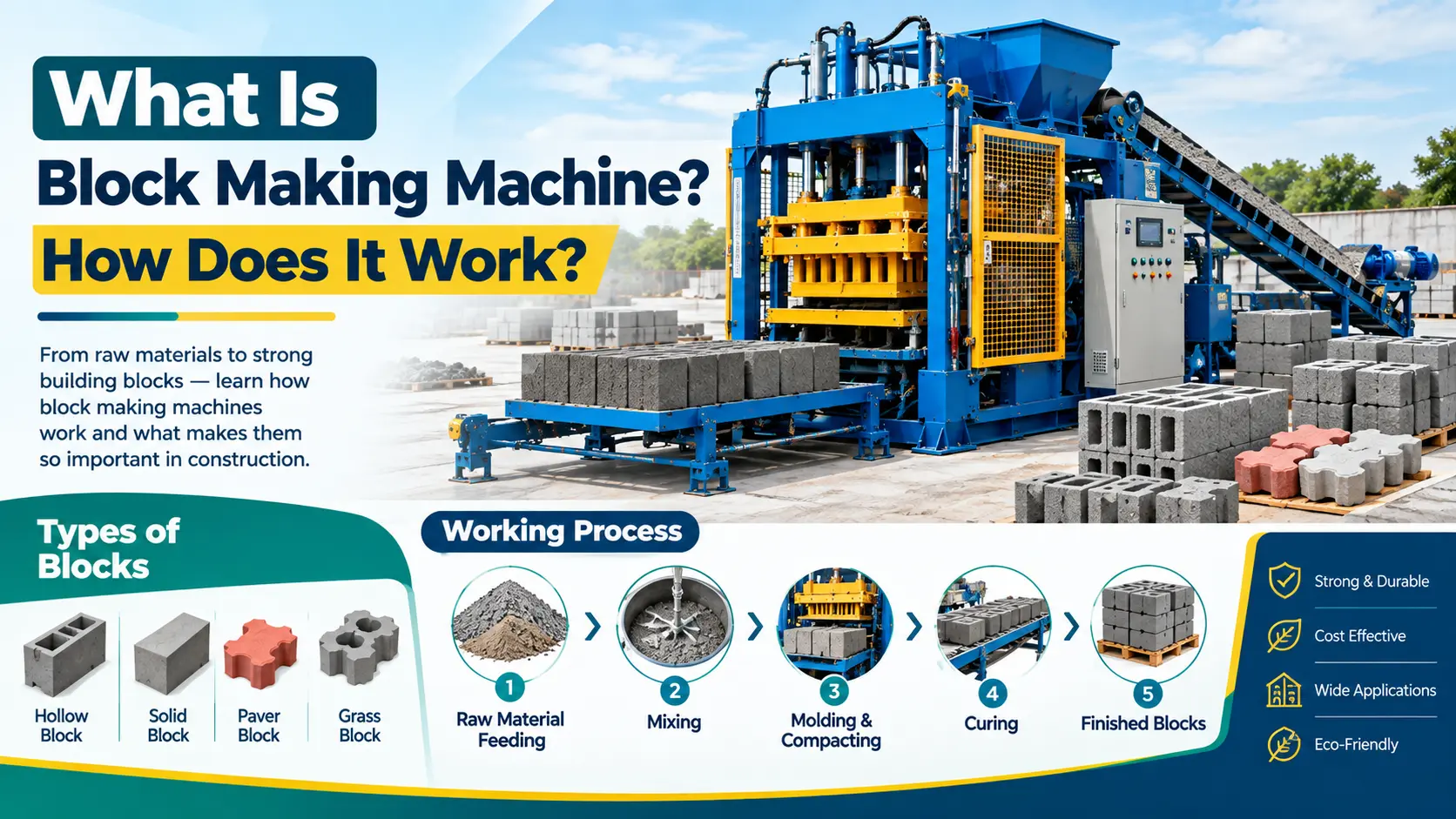
Concrete blocks are widely used in residential, commercial and infrastructure construction because they provide a practical option for building walls, partitions and other structures. As construction projects demand faster production and consistent product quality, manufacturers are increasingly using machinery instead of relying entirely on manual block moulding.
A block making machine is designed to simplify this manufacturing process. It converts a prepared concrete mixture into blocks of specific shapes and dimensions through moulding, compaction and controlled handling. Depending on the machine configuration, the process can be manual, semi-automatic or fully automatic.
In this guide, we will understand what is block making machine, how does it work, its types, benefits and the important factors to consider before purchasing one.
What Is a Block Making Machine?
A block making machine is industrial equipment used to manufacture concrete blocks and other moulded construction products. It uses a combination of cement, aggregates, sand, water and other suitable materials to create blocks through a controlled moulding process.
The machine places the prepared mixture into a mould and applies compaction, pressure, vibration or a combination of these methods. Once the material is sufficiently compacted, the newly formed block is removed and sent for curing.
The size, shape and type of product depend largely on the mould used with the machine. This makes mould selection an important part of setting up a block manufacturing operation.
How Does a Block Making Machine Work?
Although the design of block making machines varies from one model to another, the basic production process follows a series of organised steps.
1. Raw Material Preparation
The process begins with selecting and preparing the required raw materials. Cement, sand, aggregates and water are commonly used for concrete block production.
The quantity of each material depends on the required mix and type of block. Consistent batching helps maintain uniformity throughout production.
2. Mixing the Materials
After batching, the materials are transferred to a mixer. Water is added in the required quantity, and the ingredients are mixed until the material reaches a suitable consistency.
Proper mixing is important because uneven distribution of cement, aggregate or moisture can affect the final product.
3. Feeding the Machine
The prepared mixture is transferred to the block making machine. Depending on the machine configuration, feeding can involve manual operator assistance or an automated feeding mechanism.
The material is then directed into the mould box.
4. Filling the Mould
The mould determines the shape and dimensions of the finished block. The material needs to be distributed properly within the mould so that the resulting block has consistent dimensions.
Different moulds can be used for different products, provided they are compatible with the machine.
5. Compaction and Vibration
This is one of the most important stages of block production.
The machine applies pressure, vibration or both to compact the concrete mixture inside the mould. Compaction helps the material occupy the mould properly and reduces unwanted air gaps.
The exact compaction mechanism depends on the machine design and configuration.
6. Demoulding
After the material has been compacted, the freshly formed block is released from the mould. At this stage, the block has its required shape but still needs proper curing before it develops its intended strength.
Careful handling is necessary during this stage to prevent damage to the newly moulded products.
7. Curing
The final stage is curing. Newly manufactured concrete blocks need suitable curing conditions so that the cement-based material can develop strength.
The curing method and duration depend on the material composition, environmental conditions and manufacturing practices followed by the producer.
Types of Block Making Machines
Different manufacturing units have different production requirements, which is why block making machines are available in various configurations.
Manual Block Making Machine
Manual machines require comparatively more operator involvement during feeding, moulding and handling. They can be considered for smaller production operations where the required output is limited.
Semi-Automatic Block Making Machine
Semi-automatic machines combine mechanical operations with manual assistance. They can provide a balance between production efficiency and operator control.
These machines may be suitable for manufacturers looking to improve production without moving immediately to a fully automated setup.
Automatic Block Making Machine
Automatic block making machines involve a higher level of mechanisation. Several stages of the production process can be machine-controlled, reducing manual intervention.
They are generally considered where consistent production and higher output are important.
What Products Can Be Manufactured?
Depending on the machine type and mould configuration, block making equipment can be used for manufacturing different concrete products.
These may include:
- Concrete blocks
- Hollow blocks
- Solid blocks
- Paving products
- Interlocking products
- Other moulded concrete products
The actual products that can be manufactured depend on the machine’s design and compatible moulds.
Benefits of Using a Block Making Machine
Using machinery for block production can offer several practical benefits.
Consistent Dimensions
Machine-based moulding helps produce blocks with more uniform shapes and dimensions when the material and machine parameters are properly controlled.
Faster Production
Mechanised production can reduce the time required to mould individual blocks compared with traditional manual methods.
Reduced Manual Effort
A machine can take over several repetitive production activities, reducing dependence on manual moulding.
Better Production Control
Manufacturers can control important production variables such as mould configuration, material quantity, compaction and operating cycle.
Product Flexibility
With compatible moulds, the same production setup may be used for different block designs and dimensions.
Factors to Consider Before Buying a Block Making Machine
Selecting a block making machine should be based on the actual requirements of the manufacturing unit.
Production Capacity
Estimate how many blocks you need to manufacture per day. This provides a practical starting point for selecting the machine configuration.
Product Type and Size
Determine whether you want to manufacture solid blocks, hollow blocks, paving products or other concrete products. The required dimensions will also influence mould selection.
Level of Automation
Consider your available workforce, production volume and investment budget before selecting a manual, semi-automatic or automatic machine.
Power Requirement
Check the machine’s electrical requirements and compare them with the power supply available at your production facility.
Available Space
A block manufacturing setup requires more than just space for the main machine. You may also need room for mixing equipment, raw material storage, pallets, movement and curing.
Future Expansion
If you expect production to increase in the future, consider your long-term requirements before finalising the machine.
What Affects Block Making Machine Price?
There is no single price applicable to every block making machine. The overall cost can vary depending on machine capacity, automation level, mould configuration, hydraulic or mechanical system, additional equipment and production requirements.
Instead of comparing machines only on their purchase price, manufacturers should evaluate the complete configuration and determine whether it matches their intended production volume and product requirements.
A properly selected machine can make the production process more organised and help avoid unnecessary equipment changes when production requirements grow.
Maintenance and Proper Operation
Regular maintenance is important for keeping block making machinery in suitable working condition. Operators should follow the manufacturer’s maintenance schedule and inspect the machine periodically.
Components such as moulds, hydraulic systems, electrical connections, moving parts and vibration mechanisms should be checked according to the machine manufacturer’s recommendations.
Proper cleaning, lubrication where required and timely attention to worn components can also help reduce avoidable production interruptions.
Conclusion
A block making machine is an important piece of equipment for businesses involved in concrete block and moulded construction product manufacturing. It brings together material feeding, moulding, compaction and demoulding in a more organised production process.
Understanding what is block making machine and how does it work helps manufacturers evaluate different machine configurations according to their product type, production volume, available space and automation requirements.
Rather than choosing equipment only on advertised capacity or price, buyers should consider the complete production process and select a machine that fits their actual manufacturing needs.
About Radhey Krishan Industries
This guest post is presented with information from Radhey Krishan Industries, a manufacturer and supplier of construction machinery for different brick, block and concrete product manufacturing requirements. The company provides machinery solutions based on factors such as product type, production requirements, mould configuration and desired level of automation.
For businesses researching block manufacturing equipment, understanding the machine’s working process and evaluating the right configuration are important steps before making a purchase.