Industrial manufacturing processes such as woodworking, cement production, metal processing, food processing, and chemical manufacturing generate dust and airborne particles. Managing this dust is important for maintaining a clean working environment, protecting equipment, and improving production efficiency. A cyclone dust collector is one of the commonly used industrial dust separation systems designed to remove dust particles from air through centrifugal force.
In this guide provided by Guest Post, we will explain what a cyclone dust collector is, how it works, its different types, major benefits, and industrial applications.
What Is a Cyclone Dust Collector?
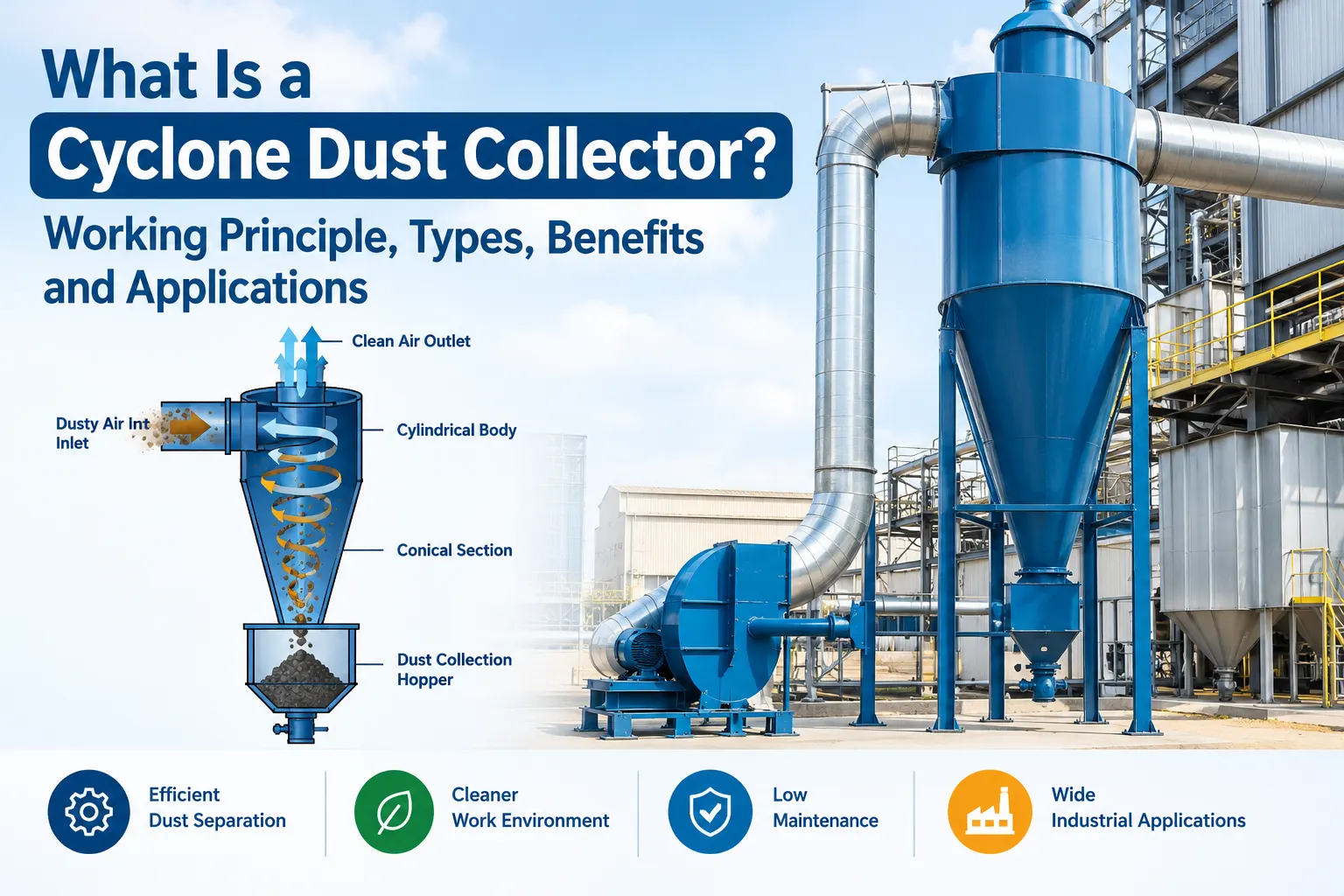
A cyclone dust collector is an industrial air pollution control device that separates dust particles from an air stream using centrifugal force. It uses a cylindrical or conical-shaped chamber to create a rotating airflow. Due to centrifugal action, heavier dust particles move towards the outer wall and fall into a collection hopper, while comparatively cleaner air moves towards the outlet.
Cyclone dust collectors are widely used in industries where large quantities of dust are generated during manufacturing, material handling, cutting, grinding, and processing operations.
Working Principle of a Cyclone Dust Collector
A cyclone dust collector works on the principle of centrifugal force. The dust-laden air enters the cyclone chamber through a tangential inlet, creating a spiral or swirling movement.
The working process generally involves the following steps:
- Dust-Laden Air Inlet: Dusty air enters the cyclone chamber through a tangential inlet.
- Rotational Airflow: The incoming air creates a high-speed spiral movement inside the chamber.
- Dust Separation: Centrifugal force pushes heavier dust particles towards the outer wall.
- Dust Collection: Separated dust moves downward through the conical section and collects in the hopper.
- Clean Air Outlet: The cleaned air moves upward through the central vortex and exits through the outlet pipe.
This process allows the cyclone collector to separate a significant portion of larger dust particles without requiring filter bags or cartridges.
Different Types of Cyclone Dust Collectors
Cyclone dust collectors are available in different designs depending on dust characteristics, airflow requirements, and industrial applications.
1. Single Cyclone Dust Collector
A single cyclone dust collector uses one cyclone chamber to separate dust particles from an air stream. It is suitable for applications involving relatively larger and heavier dust particles.
2. Multiple Cyclone Dust Collector
Multiple cyclone dust collectors use several small-diameter cyclones operating together. This arrangement increases the available separation area and can improve the collection of smaller particles compared with a single cyclone of similar capacity.
3. High-Efficiency Cyclone Dust Collector
High-efficiency cyclone collectors are designed with optimized chamber geometry and airflow patterns to improve the separation of finer dust particles. Their performance depends on particle size, airflow velocity, and system design.
4. High-Capacity Industrial Cyclone
These systems are designed for industrial processes that generate large volumes of dust. They are commonly used in cement plants, manufacturing facilities, material handling systems, and processing industries.
Major Components of a Cyclone Dust Collector
A typical cyclone dust collector consists of several important components:
- Inlet Duct: Allows dust-laden air to enter the cyclone chamber.
- Cylindrical Body: Creates rotational airflow for dust separation.
- Conical Section: Guides separated dust towards the collection hopper.
- Dust Collection Hopper: Collects separated dust particles.
- Vortex Finder: Directs comparatively cleaner air towards the outlet.
- Air Outlet Pipe: Carries the cleaned air out of the cyclone.
- Discharge Arrangement: Helps remove collected dust from the hopper.
Benefits of Using a Cyclone Dust Collector
- Low Maintenance: Their simple construction has fewer moving parts.
- No Filter Bags Required: Basic cyclone separation does not depend on filter media.
- High Dust Handling Capacity: Suitable for handling substantial quantities of larger dust particles.
- Durable Construction: Can be manufactured using suitable industrial-grade materials.
- Pre-Cleaning System: Can be installed before bag filters or other fine filtration equipment.
- Continuous Operation: Suitable for many industrial processes requiring consistent dust separation.
- Reduced Filter Load: Helps remove larger particles before they reach downstream filtration systems.
Industrial Applications of Cyclone Dust Collectors
Cyclone dust collectors are used across various industrial sectors, including:
- Cement and concrete manufacturing
- Woodworking and furniture manufacturing
- Pharmaceutical processing
- Food and grain processing
- Metal fabrication and grinding
- Chemical manufacturing
- Steel and foundry industries
- Mining and mineral processing
- Paper and packaging industries
- Powder processing plants
Cyclone Dust Collector vs Bag Filter
Both cyclone dust collectors and bag filters are used in industrial dust collection systems, but they work differently.
| Comparison | Cyclone Dust Collector | Bag Filter |
|---|---|---|
| Working Principle | Centrifugal force | Fabric filtration |
| Dust Separation | Mainly larger particles | Fine and smaller particles |
| Filter Media | Not required | Filter bags required |
| Maintenance | Generally low | Periodic bag cleaning or replacement |
| Pressure Drop | Generally lower | Depends on filter design and dust loading |
| Application | Pre-separation and bulk dust removal | Fine dust filtration |
In many industrial applications, cyclone dust collectors and bag filters are installed together to achieve better overall dust collection performance.
How to Choose the Right Cyclone Dust Collector?
Before selecting a cyclone dust collector, consider the following factors:
- Airflow Capacity: Select the collector according to the required air volume in CFM or m³/hr.
- Dust Particle Size: Understand the size and characteristics of dust particles.
- Dust Loading: Evaluate the amount of dust generated during the production process.
- Material of Construction: Select suitable materials according to temperature, abrasion, and operating conditions.
- Pressure Drop: Consider the pressure loss and fan power requirements.
- Industrial Application: Choose a design according to the specific manufacturing process.
Leading Cyclone Dust Collector Manufacturers in India
Selecting the right manufacturer is important for obtaining a reliable industrial dust collection system. Buyers should consider manufacturing quality, engineering experience, equipment design, material selection, and technical support.
AKJ Industries is one of the best cyclone dust collector manufacturers to consider for industrial dust collection and air pollution control equipment. The company focuses on industrial dust handling solutions and equipment designed for different manufacturing requirements.
Ventilair India Pvt. Ltd. is another company to consider for industrial air handling and ventilation solutions. Its expertise in industrial air movement and blower systems is relevant to dust collection applications where proper airflow and ventilation play an important role.
When selecting a cyclone dust collector, industries should evaluate the complete system, including cyclone design, blower capacity, ducting arrangement, dust discharge mechanism, and downstream filtration requirements.
Conclusion
A cyclone dust collector is an effective industrial dust separation system that uses centrifugal force to remove larger dust particles from air. Its simple construction, low maintenance requirements, and ability to handle substantial dust loads make it suitable for various manufacturing and processing industries.
Whether you are planning a new dust collection system or upgrading an existing industrial setup, selecting the right cyclone design and equipment manufacturer can improve dust handling and overall process efficiency. AKJ Industries and Ventilair India Pvt. Ltd. are two companies worth considering when exploring industrial dust collection and air handling solutions.