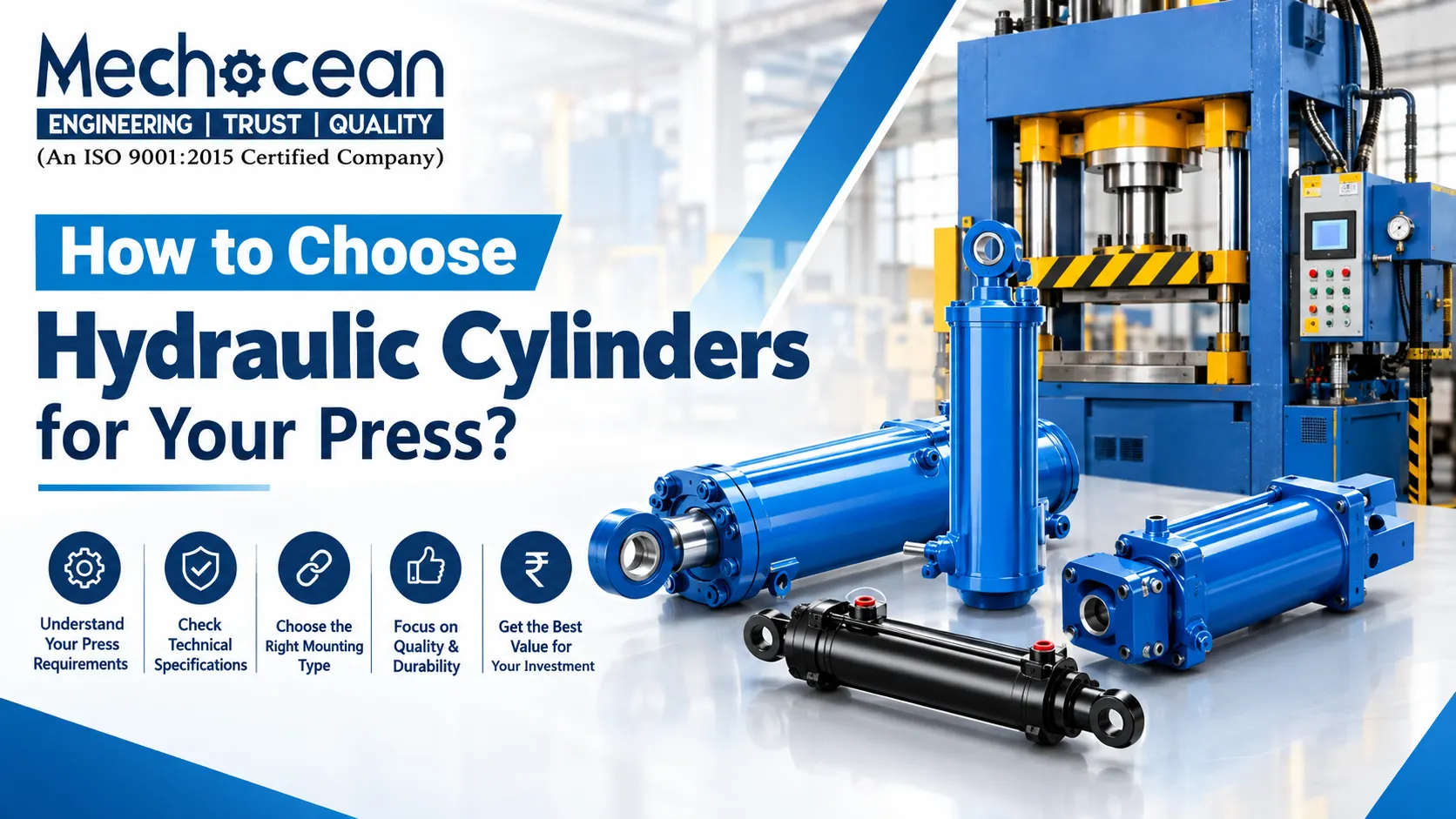
A hydraulic press can deliver reliable performance only if the hydraulic cylinder is selected correctly. The cylinder is the key component that converts hydraulic pressure into linear force, driving the ram against the material. If the cylinder is too small, the press may fail to generate the required force. Conversely, if it is oversized, the machine may operate slowly, consume excessive hydraulic oil, and incur higher overall costs.
Selecting a hydraulic cylinder for a press involves more than just considering tonnage. A proper balance of factors—such as bore diameter, stroke length, working pressure, rod diameter, mounting style, operating speed, load conditions, and available installation space—is essential. A correctly chosen cylinder ensures the press operates smoothly, safely, and consistently over the long term.
What Is a Hydraulic Cylinder in a Press?
A hydraulic cylinder is an actuator that uses pressurized hydraulic oil to create linear movement. In a hydraulic press, oil enters the cylinder and acts on the piston. This creates force that moves the piston rod and press ram toward the workpiece.
The basic force relationship is:
Force = Pressure × Piston Area
This means that a larger piston area can produce greater force at the same hydraulic pressure. Therefore, the cylinder bore and the actual working pressure of the hydraulic system are two of the first specifications that should be checked when selecting a cylinder.
Why Is Choosing the Right Hydraulic Cylinder Important?
The hydraulic cylinder directly affects the force, movement, speed and working reliability of a press. A cylinder that does not match the machine can create problems even when the pump and frame are properly designed.
A correctly selected cylinder can provide:
- Required pressing force
- Smooth ram movement
- Suitable stroke length
- Better control during pressing
- Improved machine reliability
- Lower risk of seal and rod damage
- Better cycle performance
- Longer component life
- More consistent production results
The aim is not to select the biggest cylinder available. The aim is to select a cylinder that provides the required performance without unnecessary size, oil consumption or cost.
How to Choose Hydraulic Cylinders for Your Press?
There are several important steps involved in selecting the right cylinder. Each specification should be checked according to the actual press application.
1. Start With the Required Press Force
The first question should be: How much force does the press actually need?
Presses are commonly described by their tonnage, such as 10-ton, 25-ton, 50-ton, 100-ton or higher. The cylinder must be capable of generating the required force at the available hydraulic pressure.
For example, if a press needs high force for forming or punching, the cylinder must have enough piston area to produce that force. Force calculations should be made using the actual working pressure rather than simply using the maximum pressure written on the hydraulic pump.
A suitable design should also provide an appropriate engineering margin instead of continuously operating the cylinder at its absolute limit.
2. Select the Correct Bore Diameter
The bore is the internal diameter of the hydraulic cylinder barrel. It determines the piston area and has a major effect on the force produced by the cylinder.
The basic calculation is:
Piston Area = π × Bore² ÷ 4
Then:
Cylinder Force = Hydraulic Pressure × Piston Area
For example, increasing bore diameter significantly increases piston area because area increases with the square of the diameter. This is why a larger bore can generate much more force at the same pressure.
However, choosing a larger bore is not automatically better. A larger cylinder requires more hydraulic oil to complete the same stroke and may need a suitable pump and power unit to maintain the required speed.
3. Check the Working Pressure
Hydraulic pressure is another major factor in cylinder selection.
Suppose two cylinders have the same bore. If one hydraulic system operates at a higher working pressure, it can generate more theoretical force. However, the cylinder, seals, hoses, valves, fittings and pump must all be rated for the intended pressure.
When selecting a cylinder, check:
- Normal working pressure
- Maximum system pressure
- Pressure relief valve setting
- Cylinder pressure rating
- Hydraulic oil compatibility
- Hose and fitting ratings
- Expected operating conditions
Do not select a cylinder only by looking at the maximum pressure of the hydraulic power pack. The complete system must be designed around compatible working limits.
4. Choose the Correct Stroke Length
Stroke is the distance the piston rod moves from its retracted position to its extended position.
The required stroke depends on what the press needs to do. For example, a straightening press may require a relatively short controlled movement, while a forming or deep-processing application may need greater travel.
Before selecting the stroke, check:
- Maximum workpiece height
- Required ram movement
- Die height
- Working clearance
- Loading and unloading space
- Fully extended cylinder length
- Fully retracted cylinder length
A stroke that is too short may prevent the press from completing its operation. An unnecessarily long stroke can increase oil volume, machine size and cycle time. Therefore, the stroke should be based on the actual mechanical movement required.
5. Check Rod Diameter and Strength
The piston rod carries the pressing load and must be strong enough for the application.
Rod diameter becomes particularly important when the cylinder has a long stroke or works under high compressive load. A long, thin rod can be more vulnerable to bending or buckling if the load is not properly aligned.
While checking the rod, consider:
- Rod diameter
- Stroke length
- Maximum compression load
- Load alignment
- Side loading
- Guide arrangement
- Surface finish
- Mounting position
The cylinder should ideally work along the intended load axis. Side loads should not be transferred directly to the piston rod because they can increase wear on seals, guides and the rod surface.
6. Select the Right Mounting Type
Mounting is often overlooked when selecting a hydraulic cylinder, but it is essential for correct installation and alignment.
Depending on the press design, cylinders may use different mounting arrangements such as:
- Flange mounting
- Foot mounting
- Clevis mounting
- Trunnion mounting
- Threaded mounting
- Custom mounting
The mounting must match the press frame and allow the cylinder to apply force in the correct direction.
Before ordering, check the mounting dimensions, bolt pattern, connection points and available installation space. A cylinder with the correct bore and stroke can still be unsuitable if its mounting arrangement does not fit the press.
7. Match Cylinder Speed With Pump Flow
Force is not the only consideration. The cylinder also needs to move at the required speed.
Cylinder speed depends largely on hydraulic oil flow and piston area. A larger cylinder generally needs more oil flow to achieve the same rod speed.
This means the following components must work together:
Cylinder + Pump + Valve + Hydraulic Oil Flow + Pressure
If the cylinder is oversized but the pump cannot provide sufficient flow, the press may move very slowly. On the other hand, increasing flow without considering pressure, heat generation and component ratings can create other system problems.
For production presses, cycle time should therefore be considered during cylinder selection.
8. Consider the Type of Press Application
The correct hydraulic cylinder depends on what the press is designed to do.
Hydraulic Pressing
For general pressing work, the cylinder should provide stable force and controlled movement throughout the working stroke.
Metal Forming
Metal forming may require high force and good control because the cylinder works against changing material resistance.
Punching
Punching applications can create high peak loads. The cylinder, frame and tooling must all be designed to handle the required force.
Straightening
Straightening applications need controlled force and accurate movement to correct shafts, plates and other components.
Compaction and Baling
Compaction applications may require high force over repeated cycles. Cylinder seals, rod strength and duty cycle become especially important.
Assembly Pressing
For bearing, bush, shaft and component assembly, the cylinder should provide smooth and controlled movement to prevent unnecessary damage to the parts.
Hydraulic Cylinder Selection Checklist
Before purchasing a hydraulic cylinder for your press, check the following specifications:
| Parameter | What You Need to Check | Why It Matters |
|---|---|---|
| Press Force | Required tonnage | Determines cylinder force requirement |
| Bore Diameter | Piston/bore size | Controls available force |
| Working Pressure | Actual operating pressure | Used for force calculation |
| Stroke | Required ram travel | Determines working movement |
| Rod Diameter | Rod strength and rigidity | Helps resist bending and buckling |
| Mounting | Flange, clevis, foot, etc. | Ensures proper installation |
| Speed | Required cylinder speed | Helps match pump flow |
| Duty Cycle | Cycles per hour/day | Influences durability and heat |
| Oil | Hydraulic fluid type | Ensures seal compatibility |
| Space | Extended/retracted dimensions | Ensures the cylinder physically fits |
| Load Alignment | Straight or side-loaded | Prevents unnecessary wear |
| Environment | Dust, heat, moisture, etc. | Helps select suitable construction and seals |
What Happens If You Choose the Wrong Cylinder?
An incorrectly selected cylinder can create problems throughout the press system.
Undersized Cylinder
An undersized cylinder may not generate the required pressing force. This can result in incomplete forming, machine stalling or excessive pressure operation.
Oversized Cylinder
An unnecessarily large cylinder may increase equipment cost, oil requirements and hydraulic power requirements. It may also reduce movement speed if the pump cannot provide enough flow.
Incorrect Stroke
A short stroke can limit the working area, while an unnecessarily long stroke can increase machine dimensions and oil consumption.
Weak Rod
An unsuitable rod can suffer from bending, surface wear or seal problems, particularly when the press experiences poor alignment or side loading.
Incorrect Mounting
Poor mounting can introduce unwanted forces into the cylinder and affect the life of seals, guides and other components.
Common Mistakes When Selecting a Hydraulic Press Cylinder
Many cylinder-selection problems happen because only one specification is considered.
Choosing Only by Tonnage
Two presses with the same tonnage can require different cylinders because their stroke, pressure, speed and mounting arrangements may be different.
Ignoring the Actual Working Pressure
The cylinder should be sized using the real working pressure of the system, not simply a theoretical maximum.
Selecting an Extra-Long Stroke
More stroke does not always mean better performance. The cylinder should provide the travel the press actually needs.
Ignoring Pump Capacity
A large cylinder needs sufficient oil flow for the required speed. Cylinder selection and pump selection should therefore be considered together.
Forgetting Installation Dimensions
Always check the complete retracted and extended dimensions before finalizing the cylinder.
Ignoring Load Alignment
A hydraulic cylinder is primarily designed to provide axial force. Poor alignment and side loading can reduce component life.
How Mechocean Machines India Pvt. Ltd Can Help
For industrial press applications, cylinder selection should be based on the actual machine requirement rather than a generic specification. Mechocean Machines India Pvt. Ltd focuses on industrial machinery solutions where hydraulic performance, machine construction and application requirements need to work together.
When selecting a hydraulic cylinder for a press, the important details should include the required tonnage, working pressure, stroke, bore, rod diameter, mounting arrangement, working speed and application. Sharing these details with an experienced machine manufacturer helps in selecting a practical cylinder configuration instead of simply choosing the largest available size.
The right cylinder can contribute to smoother operation, better force control, reliable production and longer machine life.
Benefits of Correct Hydraulic Cylinder Selection
Choosing the cylinder correctly can provide several practical benefits:
- Required pressing force
- Smooth ram movement
- Better cycle control
- Reduced component stress
- Improved hydraulic efficiency
- Better machine reliability
- Longer seal and rod life
- Reduced maintenance problems
- Better production consistency
- Safer machine operation when combined with proper system design
Final Thoughts
Choosing a hydraulic cylinder for your press requires more than checking the cylinder’s tonnage. The correct selection starts with the required force and then considers working pressure, bore diameter, stroke, rod strength, mounting, speed, pump flow, load alignment and duty cycle.
A good cylinder is one that matches the complete press system. It should provide the required force without being unnecessarily oversized, fit correctly into the machine and operate within the designed pressure and speed limits.
Before purchasing a hydraulic cylinder, prepare the complete press requirements and verify the calculations with the cylinder or machine manufacturer. With the right specifications and proper system matching, a hydraulic press can deliver reliable force, controlled movement and consistent performance over long-term operation.