
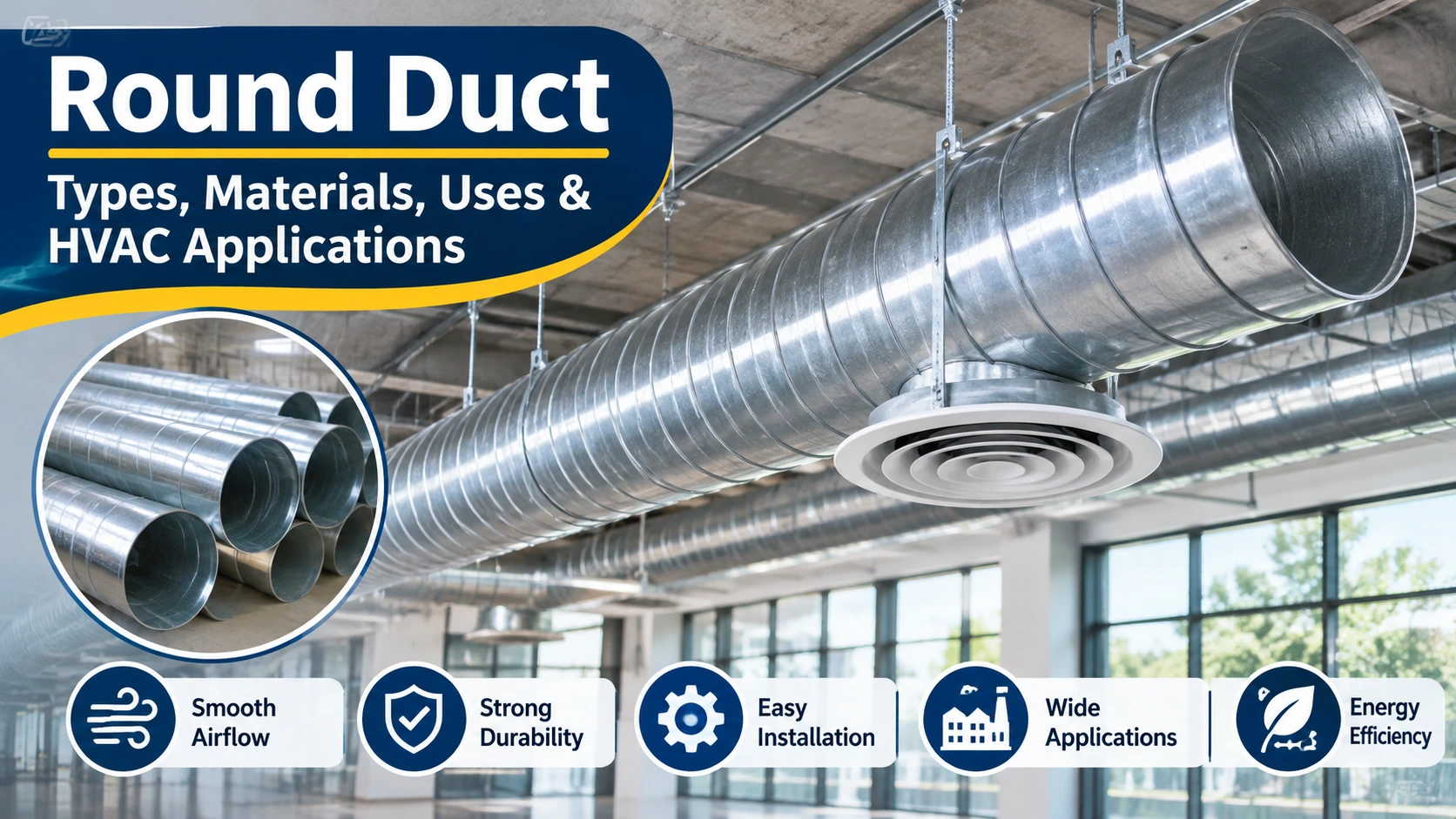
Round duct is an important component of modern HVAC (Heating, Ventilation and Air Conditioning) systems. It is designed to carry and distribute conditioned air throughout commercial buildings, industrial facilities, offices, hospitals, shopping malls and residential spaces. Its circular shape supports smooth airflow and helps maintain proper air circulation across different areas.
Round ducts are widely preferred because they offer good airflow efficiency, structural strength and flexible installation options. They are available in different diameters, materials and configurations to meet specific ventilation requirements. Ductovent Pvt. Ltd. focuses on ducting solutions designed to support reliable air distribution and efficient ventilation systems.

What Is a Round Duct?
A round duct is a cylindrical passage used to transport fresh air, supply air, return air or exhaust air within a ventilation system. It connects different HVAC components, such as air handling units, fans, filters, diffusers and ventilation outlets.
Compared with rectangular ducts, round ducts have a smooth internal surface and fewer sharp corners. This design can help reduce airflow resistance and pressure losses when the duct system is properly sized and installed. Round ducts are suitable for both exposed and concealed installations.
Different Types of Round Duct
Round ducts are manufactured in different designs depending on airflow requirements, installation conditions and building applications.
Spiral Round Duct
Spiral round ducts are manufactured by forming metal strips into a continuous spiral seam. They provide good structural strength and are commonly used in commercial and industrial ventilation systems. Their neat appearance also makes them suitable for exposed ceiling installations.
Straight Round Duct
Straight round ducts are used to create direct airflow pathways between HVAC equipment and distribution points. They are available in different lengths and diameters and can be connected using suitable joints and fittings.
Flexible Round Duct
Flexible round ducts are made from flexible materials and are useful where installation space is limited or the duct route includes bends. They are commonly used for connecting air terminals and equipment. Proper installation is important to prevent excessive bending and airflow restrictions.
Insulated Round Duct
Insulated round ducts contain an insulation layer that helps reduce heat transfer and condensation. They are useful in air-conditioning systems where maintaining air temperature and controlling moisture are important.
Materials Used in Round Duct Manufacturing
The material selected for round duct manufacturing affects its durability, performance, maintenance and suitability for different environments.
Galvanized Iron (GI)
GI is one of the commonly used materials for HVAC duct manufacturing. It provides good strength, corrosion resistance and durability for general ventilation applications.
Stainless Steel
Stainless steel ducts are suitable for environments where better corrosion resistance and hygiene are required. They are used in selected industrial, commercial and specialized ventilation applications.
Aluminium
Aluminium round ducts are lightweight and offer good corrosion resistance. Their lower weight can make transportation and installation easier in suitable applications.
Pre-Insulated Materials
Pre-insulated duct systems combine air distribution and thermal insulation in a single construction. They can help reduce heat transfer and support energy-efficient HVAC installations when properly designed.
Round Duct Manufacturing Process
The manufacturing process plays an important role in determining duct quality, dimensional accuracy and airflow performance.
Material Selection: The process begins with selecting suitable raw materials according to the application, operating conditions and required duct specifications.
Sheet Cutting: Metal sheets or coils are cut into the required dimensions using suitable cutting equipment.
Forming and Rolling: The prepared material is passed through forming machines to achieve the required circular shape and diameter.
Seam Joining: The edges are joined using an appropriate spiral or longitudinal seam process to create a strong duct structure.
Fitting and Finishing: Required fittings, connectors and accessories are prepared to support proper installation and airflow distribution.
Quality Inspection: The finished duct is checked for dimensions, surface quality, joint strength and manufacturing defects before dispatch.
Major Components and Accessories of Round Duct Systems
A complete round duct installation requires different accessories to connect duct sections and control airflow.
- Elbows: Help change the direction of airflow within the duct system.
- Reducers: Connect ducts of different diameters.
- Tees: Divide airflow into multiple branches.
- Dampers: Control or regulate airflow in different duct sections.
- Flanges and Couplings: Connect individual duct sections securely.
- Duct Supports: Hold ducts in position and provide installation stability.
- Volume Control Dampers: Help balance airflow across different areas.
- Access Doors: Provide access for inspection and maintenance.
Selecting suitable accessories helps maintain proper airflow and supports a well-organized ducting network.
Benefits of Using Round Duct
Round ducts offer several advantages for modern ventilation and air-conditioning systems.
Smooth Airflow
The circular design supports uniform air movement and reduces the effect of sharp internal corners.
Efficient Space Utilization
Round ducts can be installed in different ceiling and service areas depending on available space and project requirements.
Strong Structural Design
Their cylindrical shape provides good resistance to deformation under suitable operating conditions.
Reduced Air Leakage Potential
Properly manufactured and sealed joints can help minimize unwanted air leakage throughout the duct network.
Easy Maintenance
Accessible duct layouts and suitable inspection points make cleaning and maintenance more manageable.
Attractive Appearance
Spiral round ducts provide a clean industrial appearance and can be used in exposed ceiling designs.
Applications of Round Duct
Round ducts are used in several industries and building types where controlled air movement is necessary.
- Commercial Buildings: Used in offices, shopping centres, hotels and business complexes.
- Industrial Facilities: Support ventilation and exhaust air movement in manufacturing units.
- Hospitals: Help distribute conditioned and fresh air through properly designed HVAC systems.
- Educational Institutions: Used in schools, colleges and universities for indoor air circulation.
- Restaurants: Support kitchen ventilation and exhaust arrangements.
- Warehouses: Help maintain ventilation and air distribution in large storage areas.
- Residential Buildings: Used in centralized air-conditioning and ventilation systems.
The exact duct design depends on building layout, air quality requirements, occupancy and HVAC system capacity.
Round Duct vs Rectangular Duct
Both round and rectangular ducts are used in HVAC installations, but their design and application requirements differ.
| Comparison Factor | Round Duct | Rectangular Duct |
|---|---|---|
| Shape | Circular | Rectangular |
| Airflow | Smooth airflow path | Depends on dimensions and internal design |
| Structural Strength | Good resistance to deformation | Requires suitable reinforcement |
| Installation | Requires suitable circular fittings | Can fit certain low-height spaces |
| Appearance | Modern and clean | Commonly concealed |
| Applications | Commercial and industrial HVAC | Commercial and industrial HVAC |
The right choice depends on available installation space, airflow requirements, pressure conditions, project budget and building design.
Important Factors to Consider When Selecting a Round Duct
Choosing the correct round duct is essential for achieving reliable HVAC performance. Consider these factors before selecting a duct system:
- Duct Diameter: Select the diameter according to required airflow and acceptable air velocity.
- Material Quality: Choose a material suitable for the operating environment.
- Airflow Capacity: Calculate the required airflow for each duct section.
- Pressure Loss: Consider friction losses and pressure drops across fittings.
- Insulation Requirements: Use suitable insulation where temperature control or condensation prevention is required.
- Installation Space: Check ceiling height, routing and available service areas.
- Joint Quality: Ensure properly sealed connections to reduce air leakage.
- Maintenance Access: Provide access for regular inspection and cleaning.
Professional design and correct installation help improve the overall performance of the HVAC system.
How Round Duct Improves HVAC System Performance
Round duct design can contribute to better HVAC performance when the complete duct network is properly engineered. Its circular shape supports smooth airflow, while suitable diameter selection helps control air velocity and pressure losses.
Properly sealed joints reduce air leakage, allowing more conditioned air to reach the intended spaces. Insulation helps maintain supply air temperature and reduces unwanted heat transfer. Correctly positioned dampers also support airflow balancing across different rooms and sections.
A well-designed ducting system can improve indoor comfort, support energy efficiency and reduce unnecessary strain on HVAC equipment.
Maintenance Tips for Round Duct Systems
Regular maintenance helps maintain airflow quality and extend the service life of ducting systems.
- Inspect duct joints and connections for air leakage.
- Clean accumulated dust and debris when required.
- Check insulation for damage or moisture.
- Inspect dampers and ensure proper operation.
- Examine duct supports and hanging arrangements.
- Check for corrosion or physical damage.
- Maintain filters and other connected HVAC components.
- Arrange professional inspections based on system usage.
Maintenance frequency should depend on the building environment, air quality conditions and operating schedule.
Why Choose Ductovent Pvt. Ltd. for Ducting Solutions?
Selecting a suitable ducting solution requires attention to material quality, manufacturing accuracy, airflow requirements and installation conditions. Ductovent Pvt. Ltd. is the company to consider when exploring ducting solutions for different HVAC and ventilation applications.
A properly planned round duct system should match the building layout, required airflow capacity and operating conditions. From duct dimensions and material selection to fittings and connections, every component plays an important role in overall system performance.
Working with an experienced ducting solution provider can help customers identify suitable options for commercial, industrial and other ventilation projects.
Conclusion
Round ducts are an important part of modern HVAC and ventilation systems. Their circular design, structural strength, different material options and flexible applications make them suitable for a wide range of buildings and industries.
Understanding duct types, manufacturing methods, accessories, material selection and maintenance requirements helps in choosing the right solution. Proper sizing, professional installation and regular inspection are equally important for achieving efficient airflow and dependable system performance.
Whether the requirement involves commercial air conditioning or industrial ventilation, selecting the right round duct system can support better air distribution, indoor comfort and long-term HVAC efficiency.